MrWarnerRobins.org
MrWarnerRobins.org
The People. The Meetings. The Record.
Civic Center brings the documentary history of Warner Robins government out of the archive and into public view.
Explore the people who have shaped City Hall, the meetings where public business was conducted, and the records left behind. Featured here are selected dossiers from Executive Theater, official Warner Robins City Council records from 2019–2026, and public meetings preserved as part of the city's continuing civic record.
This page is a curated entrance to a much larger collection. The underlying documents, source material, and complete record remain preserved in the Warner Robins Archive and Records Room of The Davidson Report.
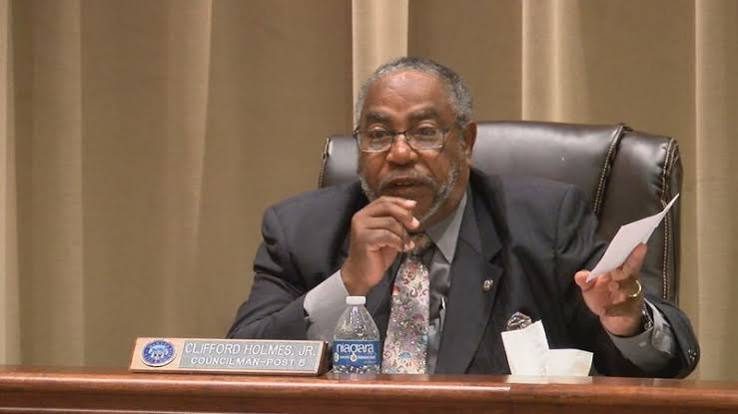
The “Godfather” of City Hall
Warner Robins’ longest-serving current councilman (Post 5) carries an unusual institutional history: decades in Houston County education, council service reaching back at least to 2006, and two separate periods in which he stepped into the mayoral role—most notably about 71 days during Mayor Donald Walker’s 2008 medical absence.
Yet behind one of City Hall’s most familiar faces is one of its least recoverable family histories. Despite an extensive search reaching back to his Jacksonville childhood, Holmes’ parents—and the lineage behind the “Jr.”—remain unresolved in the public record.
Called the “Godfather” by colleagues in recognition of his longevity and experience, Holmes provides a rare living bridge between the Walker era and Warner Robins government today.

JANUARY — JUNE
The first half of 2019 captures Warner Robins City Council during a period of heavy infrastructure, utility and development activity. The record follows sewer expansion, water meters and leak surveys, stormwater projects, redevelopment and annexations, major procurement, and repeated executive sessions involving utilities, personnel, real estate and litigation.
It also records a government beginning to formalize new ethics and personnel policies, expand surveillance technology, and confront occasional breaks from its otherwise strongly consensus-driven voting pattern. Together, these meetings provide a six-month snapshot of how the city was operating, spending and making decisions under Mayor Randy Toms and the 2019 Council. 01 – 2019 pt I Council Meeting …
RANDY TOMS
Firefighter to Mayor
Randy Toms came to the mayor’s office from inside Warner Robins government, following a 27-year career with the Warner Robins Fire Department. Elected in 2013 and reelected in 2017, he served eight years as mayor during a period marked by municipal growth, major development projects, public-safety investment, and a fundamental shift in how City Hall was administered.
His administration also became entangled in consequential personnel and governance disputes—several of which continued through litigation after he left office. At the same time, Warner Robins moved from its traditional mayor-centered structure toward the professional City Administrator model that remains part of city government today.
Toms left City Hall in January 2022 and returned to his professional roots, becoming Executive Director of the Georgia Firefighter Standards and Training Council.
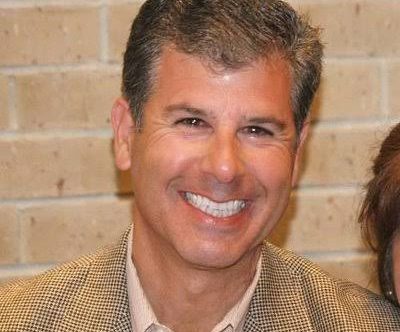
CHUCK SHAHEEN
Mayor, Councilman & Institutional Bridge
Chuck Shaheen entered the mayor’s office through one of Warner Robins’ most consequential transitions, winning the 2009 special-election runoff following Donald Walker’s death and John Havrilla’s interim succession. His 2010–2013 administration inherited major Walker-era initiatives while emphasizing Robins AFB advocacy, development, recreation and capital projects.
But Shaheen’s story did not end with the mayoralty. In 2013, he chose not to seek reelection as mayor and instead moved into an at-large City Council seat, later returning to the mayoral ballot in 2017. His public career also extended into regional utility governance through the Municipal Gas Authority of Georgia.
That unusual path—civic advocate → mayor → councilman → mayoral candidate—makes Shaheen an important bridge between the Walker and Toms eras of Warner Robins government.
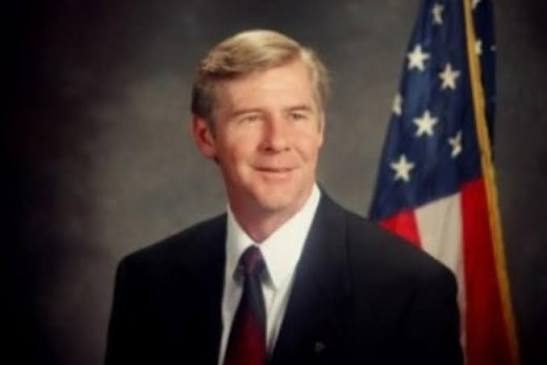
DONALD S. WALKER
The Fifteen-Year Mayor
Donald Walker served as mayor from 1994 until his death in office in 2009, presiding over fifteen years of Warner Robins growth. His tenure encompassed annexation, commercial and industrial recruitment, public works, redevelopment, an expanding relationship with Robins AFB, and the beginnings of institutional arrangements that continued long after his administration.
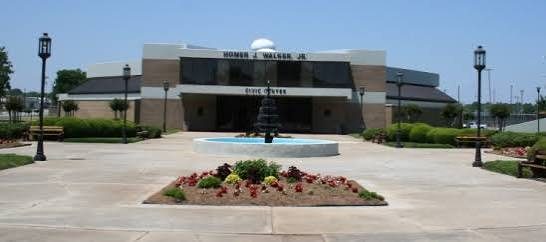
Walker was also second-generation City Hall. His father, Homer J. Walker Jr., had served as mayor from 1968–1972, while the Walker family's documented involvement in Warner Robins land development reaches back another generation.
His final years intersected with major changes in utilities, downtown redevelopment, Commercial Circle and defense-linked development. Then, on September 28, 2009, Walker died while seeking another term. His death was officially ruled suicide, but later gunshot-residue questions, the mayoral succession, and an extraordinary records-custody incident inside City Hall left portions of the final chapter unresolved in the surviving public record.

LAMONTIE L. “MONTIE” WALTERS
The Utility Continuity
Montie Walters is one of the longest-running operational figures in modern Warner Robins government. His career moved from City animal control into utility work and pollution control, through private operation of City wastewater facilities, and eventually into senior City utility management. He was appointed Utility Director in September 2007 and remains in that position in 2026.
That longevity places Walters across an unusually large span of Warner Robins infrastructure history. He entered the directorship during Mayor Donald Walker’s administration and within weeks of ESG's 2007 operational takeover. He remained through the post-Walker transition and the Shaheen, Toms and Patrick administrations, spanning the development of the modern water-audit system, gas-system regulation, major water and sewer expansion, and the current SCADA modernization program.
Today, his department reaches across water and sewer administration, sewage collection and disposal, water distribution, and natural-gas distribution. That makes Walters an important institutional link between the infrastructure Warner Robins inherited, the systems it operates today, and the records needed to understand how those systems changed over nearly two decades.

CRAIG L. CLIFTON
Three Decades Inside Public Works
Craig Clifton is one of Warner Robins’ longest-serving operational officials. His City career reaches back to approximately 1996, placing him inside Public Works for most of Donald Walker’s administration and through the Shaheen, Toms and Patrick eras. He rose through that system rather than arriving from outside—becoming a Public Works supervisor, interim director and finally Director of Public Works in 2021.
Today, Clifton’s department touches much of the city's physical footprint: streets, facilities, grounds, fleet, central receiving, refuse services, stormwater structures and emergency response. That puts Public Works alongside Utilities wherever roads, drainage and buried infrastructure intersect.
Nearly thirty years in the same municipal operating system also makes Clifton a significant source of institutional memory—someone whose career spans infrastructure built, repaired and modified long before many of today’s records and systems existed.

PRESTON EMERSON POOSER
The Recreation Builder
Preston Pooser arrived in Warner Robins in 2025 with roughly 35 years in municipal recreation, including director-level work in Mississippi, Alabama, Georgia and Florida. His career has centered on a broader model of recreation—parks, trails, sports tourism, amphitheaters, festivals, cultural programming, facilities and public-private partnerships. Preston Pooser
Warner Robins hired him into an unusually consequential transition. Longtime director Jarred Reneau departed after 25 years, and just 49 days later Council appointed Pooser while simultaneously renaming and expanding the department into Recreation, Parks and Cultural Services. Preston Pooser
Pooser’s professional history also intersects City Administrator James Drinkard’s: a 2026 correspondence record documents that the two had used the same trail-signage approach in other communities before working together in Warner Robins. Preston Pooser
Warner Robins Government — On the Record
Government is more than documents. It is also what happens in the room.
This rotating collection features selected City meetings, public addresses and other official proceedings, presented so visitors can see and hear Warner Robins government for themselves. The recordings are drawn directly from the City of Warner Robins’ own publicly released video archive and are periodically updated as new or historically significant meetings are added.
Watch the proceedings. Hear the discussion. Then explore the records elsewhere in Civic Center and the Warner Robins Archive.
March 11, 2026 • Museum of Aviation
Mayor LaRhonda Patrick delivered Warner Robins’ 2026 State of the City Address from the Century of Flight Hangar at the Museum of Aviation, before civic leaders, community partners, residents and other stakeholders. The public event was built around the City’s “Taking Flight” theme and presented the administration’s account of Warner Robins’ progress, challenges and direction entering Patrick’s second term.
Patrick highlighted the Real Time Crime Center, InnoLab, Haven Hope House, downtown and Commercial Circle redevelopment, transportation planning and the Vietnam Veterans Memorial, while introducing Project 2051 as a longer-range effort to involve residents—including youth—in shaping the city's future.
More than a ceremonial address, the recording preserves a useful benchmark: what Warner Robins leadership publicly identified as its accomplishments, priorities and promises in March 2026.
June 15, 2026 • Warner Robins City Hall
The June 15 meeting marked a significant point in Warner Robins’ 2026 operating year. Mayor and Council adopted the FY2027 budget and approved a series of contracts and purchases affecting City operations. The City's official budget notice confirms June 15 as the scheduled adoption meeting.
Among the most consequential actions was a new landscape-maintenance structure dividing City work among multiple contractors. TriScapes was awarded public right-of-way mowing, alongside separate contracts for parks and recreation properties and designated stormwater ponds. The discussion also raised questions about local versus out-of-area vendors and how Warner Robins would manage these services going forward.
This recording preserves the meeting where TriScapes formally entered the Warner Robins record and provides the original public discussion surrounding decisions that would become increasingly significant later in 2026.
August 17, 2026 • Warner Robins City Hall
The August 17 meeting provides a cross-section of Warner Robins government at work, with Mayor and Council considering land use, City finances, personnel and public-safety concerns. Council approved multiple rezoning matters, authorized budget transfers involving street lighting and vehicle purchases, and amended portions of the City's employee classification plan.
The public-comment period broadened the record considerably. Residents addressed traffic safety on Gun Road, the concentration of vape stores near young people, homelessness, and recreational accessibility for people with disabilities. Council also observed a moment of silence in support of Warner Robins High School following the August school incident.
Rather than documenting a single major decision, this meeting preserves something equally useful: a snapshot of the issues reaching City Hall from both the government and the community during the summer of 2026.
From Promise to Operation — The Record of 79 Green Street
Haven Hope House began not as a purpose-built shelter, but as a 1968 commercial/warehouse property at 79 Green Street. The City of Warner Robins acquired the property on April 17, 2023 for $175,000, then began converting the roughly 7,138-square-foot, M1-zoned building into what was promoted as Warner Robins’ first City-owned homeless shelter. By May 2023, Council had formally authorized the City to receive donations for the future facility.
The public promise was considerably larger than providing emergency beds. Mayor LaRhonda Patrick described the future shelter in 2023 as a place of “hope, love” and “transformation,” presenting it as an alternative to simply citing people experiencing homelessness. Public plans contemplated capacity for more than 70 people, while later messaging emphasized structured programming, dignity, reintegration, employment and housing assistance. By the 2025 campaign, BUILD Haven Hope House had become part of the administration's “Promises Made, Promises Kept” record.
Turning that promise into a functioning facility proved more complicated. The warehouse required adaptive reuse, renovation and environmental remediation, including publicly acknowledged mold work. In 2024 the City created a Shelter Supervisor position within the City Administrator's Office, issued a commercial-remodeling permit and ultimately authorized a construction agreement for renovations and additions.
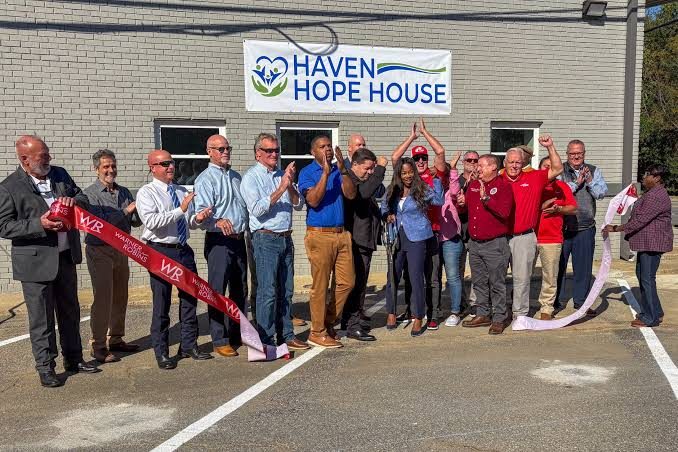
On October 17, 2025, Warner Robins held the ribbon cutting. Contemporary coverage presented Haven Hope House as the City's new full-service homeless shelter, with beds, meals and support intended to include employment and housing assistance. The operating model, however, was already divided: the City owned the facility while The Assembly served as the operating partner. The ceremony marked the public culmination of a project that had taken several years to acquire, renovate and launch.
Then the record changed.
During early 2026, Haven Hope House did not operate as the continuously available shelter the ribbon-cutting coverage could reasonably have led the public to expect. Its overnight operations were largely intermittent and weather-triggered. In February, shelter leadership publicly acknowledged that it was still “working through logistics,” while future plans included expanded daytime services and a 90-day program. In March, 13WMAZ documented the facility remaining closed during at least one period of freezing temperatures.
The governance record eventually clarified what had happened operationally. The City stated that it conducted the first two openings, but after agreements were executed, day-to-day operation and recordkeeping passed to The Assembly. City Administrator James Drinkard further clarified that operational decisions—including whether the facility opened—belonged to The Assembly. At the same time, the City retained ownership and responsibilities for building maintenance, utilities, janitorial service, landscaping and other infrastructure costs.
By mid-2026, the practical role of Haven Hope House had shifted toward limited services, outreach and resource-center functions rather than continuous residential sheltering. That evolution does not erase the original project or the services being provided. It does, however, make the complete chronology important: land acquisition → public promise → adaptive reuse → construction and remediation → ribbon cutting → operational transfer → intermittent shelter openings → limited-service/resource-center operation. The archive is designed to preserve that entire sequence rather than only the announcement or the ribbon cutting.
We need your consent to load the translations
We use a third-party service to translate the website content that may collect data about your activity. Please review the details in the privacy policy and accept the service to view the translations.