document • investigate • engage • reform
document • investigate • engage • reform
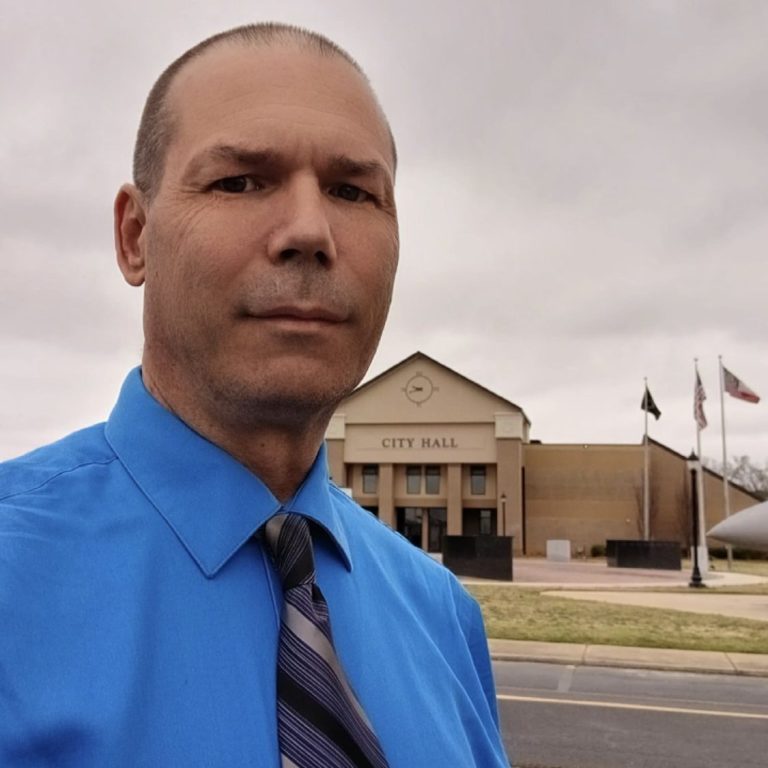
Middle Georgia's Most Independent, Persistent Civic Watchdog
Civic Watchdog • Pro Se Litigator • Constitutional Rights Advocate • Mr Warner Robins
ANDREW DAVIDSON
CIVIC WATCHDOG • PRO SE LITIGATOR • CONSTITUTIONAL RIGHTS ADVOCATE • MR WARNER ROBINS
Andrew Davidson’s path to civic accountability did not begin with Warner Robins, social media, or a website.
It developed over decades spent working inside—and examining—complex organizations where understanding what happened often required looking beyond the obvious answer.
Davidson served in the United States Navy from 1997 to 2000, including service aboard nuclear-powered fast-attack and ballistic-missile submarines. His military experience placed him in high-reliability environments built around procedural discipline, compartmentalized information, redundant systems, documentation, secure communications, and decision-making where seemingly small failures could carry significant consequences.
That experience became an early foundation for the way he approaches institutions today: systems matter, records matter, and failures rarely exist entirely in isolation.
His professional life subsequently crossed business operations, organizational restructuring, consulting, research, community advocacy, and high-stakes decision support. Across those environments, Davidson developed an unusual professional background centered less around a single industry than around understanding how organizations actually function—how information travels, how decisions are made, where accountability resides, and what happens when the structure described on paper differs from the structure operating in practice.
In 2004, Davidson was invited to participate in a compartmentalized think-tank study group examining hypothetical future governance, technology, infrastructure, and regulatory systems. His working group examined infrastructure and technology concepts, including emerging data infrastructure, camera and surveillance systems, and potential policy structures. Because portions of the work were compartmentalized and Davidson describes the engagement as subject to confidentiality restrictions, the significance and later relationship of that work to subsequent national initiatives is addressed separately in his personal archive and memoir rather than presented here as independently established fact.
Years later, Davidson found himself working at the opposite end of institutional research: not inside a study group, but walking neighborhoods.
During the Flint water crisis, Davidson was invited to contribute to field and research work connected with members of Erin Brockovich’s team. He did not work directly with Brockovich herself. His role was decidedly less glamorous—and perhaps more formative.
He attended public meetings. He reviewed agendas, municipal records, previous cases and historical material. Then he went door to door.
Davidson spoke with residents, listened to their accounts, documented their experiences and assisted with collecting statements and affidavits. The work required moving continuously between what institutions recorded on paper and what people living inside the affected community said was happening on the ground.
That distinction would become central to his later work.
Davidson has also served in community intake and outreach roles, assisting individuals seeking mental-health and domestic-violence resources while working alongside licensed professionals. His broader career has included decades of restaurant and multi-unit operations, consulting, organizational restructuring and business development—experience that exposed him to everything from budgets and procurement to staffing systems, contracts, operational controls and executive decision-making.
These experiences eventually converged in Warner Robins, Georgia.
What began as Davidson documenting matters affecting his own life expanded into sustained examination of municipal government, public records, court proceedings, redevelopment, public spending, infrastructure, homelessness, environmental questions and the institutional history of Warner Robins itself.
Today that work operates publicly as Mr. Warner Robins™.
Davidson attends government meetings, files and analyzes open-records requests, conducts field investigation, interviews residents and officials, preserves photographs and video, studies historical records, constructs timelines and compares public statements against underlying documentation.
The objective is not to ask the public to accept his conclusions because of his biography.
It is precisely the opposite.
The work should be capable of standing without him.
Wherever possible, the documents, recordings, government records, photographs, correspondence and source material underlying an investigation are preserved so readers can examine the evidence themselves, challenge the conclusions and reach their own.
Because credibility should never depend entirely upon who is telling the story.
It should depend upon whether the record survives scrutiny.
THE STORY BEHIND THE WORK
The on-going memoirs below trace the experiences, people, victories, failures, and unexpected turns that shaped Andrew Davidson—and ultimately Mr. Warner Robins™.
Field Principle I — Professional Reach-Out Decorum
Approach every engagement as a mutual evaluation, not a request for approval.
Whether you are entering a room as a candidate, a collaborator, or even in a position of need—your posture determines the structure of the interaction.
When you enter waiting to be assessed, you unconsciously lower your position. You begin to over-explain, justify, and seek alignment prematurely. In doing so, you give away clarity before it has had the chance to form.
When you instead approach the interaction as someone who is also evaluating, your behavior changes.
You become more precise.
You ask better questions.
You observe instead of perform.
You allow the other party to demonstrate their capability, their intent, and their alignment—without interference.
This posture is not about dominance or control.
It is about grounded presence.
It does not accelerate relationships—it strengthens the right ones and exposes the wrong ones early.
You are no longer seeking to be accepted.
You are determining whether alignment exists.
And in that shift, something subtle but critical happens:
you stop forcing outcomes, and you begin recognizing them.
“The moment you stop seeking approval, you start receiving clarity.”
— Andrew Davidson
“For am I now seeking the approval of man, or of God? Or am I trying to please man? If I were still trying to please man, I would not be a servant of Christ.”
— Galatians 1:10
These frameworks represent decades of operational observation, research, development, consulting and systems thinking, beginning in hospitality and retail and expanding into municipalities, institutions and larger interconnected systems. Together, they examine a question that has followed my work across industries and environments:
how much pressure can a system absorb, adapt to and recover from before growth becomes instability and continuity begins to fail?
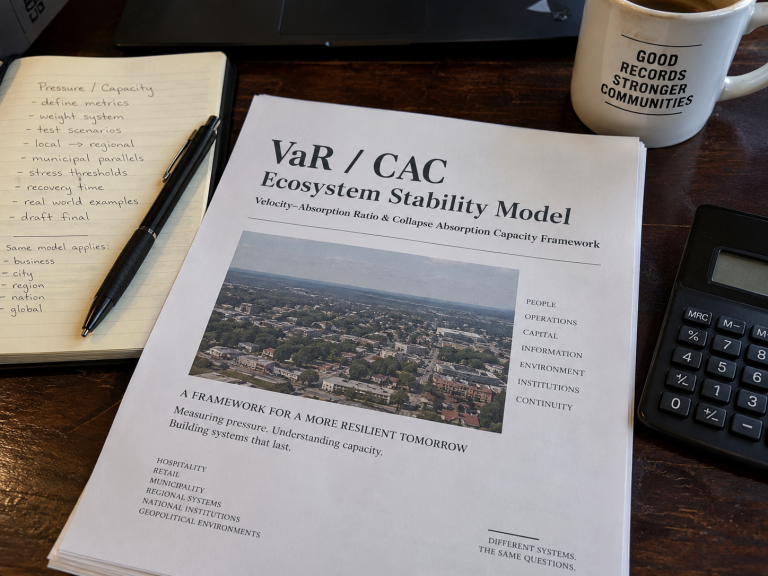
MEASURING PRESSURE BEFORE FAILURE BECOMES VISIBLE
The VaR / CAC Ecosystem Stability Model grew slowly from decades of operational research, development, systems architecture, assessment and consulting across hospitality, retail and complex organizations. At its center is one of my oldest operating principles: pressure itself is not the problem; instability begins when sustained pressure exceeds a system’s ability to absorb it, recover from it and preserve continuity.
Only recently, through my own experiences and a deeper examination of Middle Georgia’s civic, commercial and institutional ecosystem, did I begin applying that principle beyond traditional business operations. The same relationships between pressure, capacity, continuity, recovery and expansion can be examined across businesses, municipalities, regional institutions and increasingly interconnected national and geopolitical systems. Since 2020 especially, decisions made locally, nationally and internationally have demonstrated how rapidly pressure can move across systems once treated as separate—from a storefront or city government to financial markets, federal policy and the White House. VaR / CAC provides a framework for measuring those relationships without requiring a political conclusion before the evidence is examined.
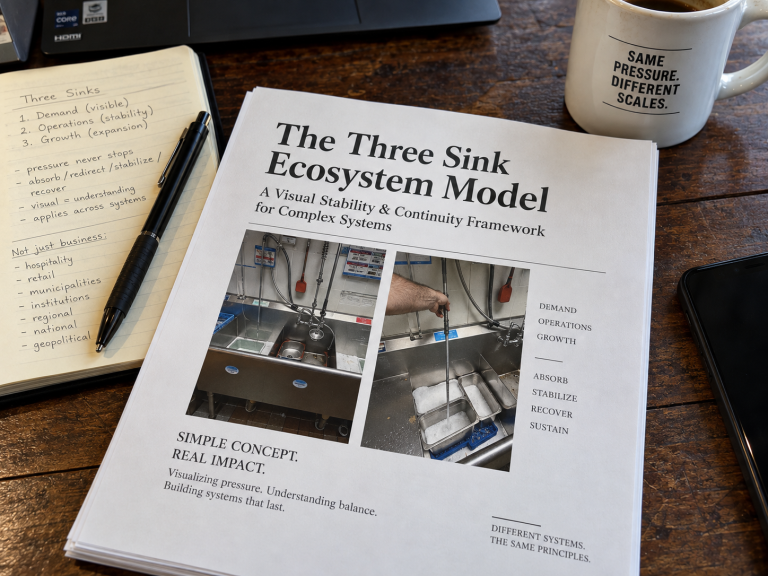
MAKING COMPLEX SYSTEM PRESSURE VISIBLE
The Three Sink Ecosystem Model is the visual counterpart to VaR / CAC. Its origin is deliberately simple: three sinks, continuous inflow and finite capacity. One represents immediate demand, another the continuity and recovery infrastructure required to sustain the system, and the third the pressure created by growth and expansion. When demand and expansion consistently increase faster than continuity capacity, the system may continue appearing successful even while instability accumulates underneath it.
I developed this way of thinking over decades of operating, assessing, designing and consulting within real-world systems, where the consequences of imbalance are often visible long before anyone gives them a formal name. What began as an operational way to understand hospitality and retail now provides a common language for examining much larger systems—from organizations and municipalities to regional networks, national institutions and geopolitical relationships. The scale changes. The actors change. The form of pressure changes. The underlying question does not: can the system absorb what is being asked of it without sacrificing its ability to recover and remain stable?
We need your consent to load the translations
We use a third-party service to translate the website content that may collect data about your activity. Please review the details in the privacy policy and accept the service to view the translations.